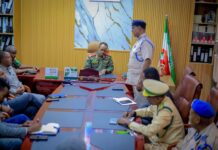
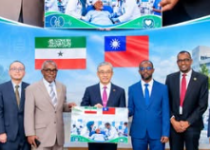
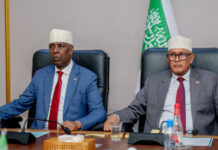


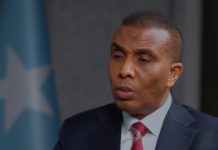




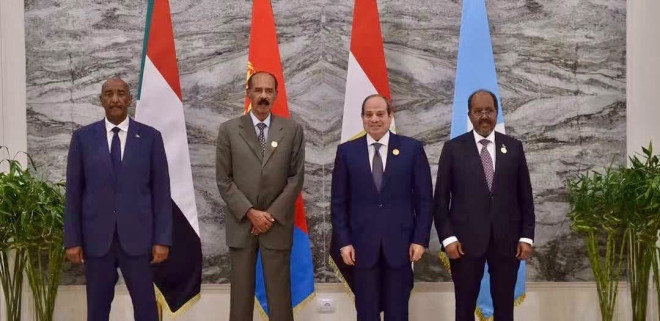
The leaders of Egypt, Sudan, Eritrea, and Somalia held a summit in the Egyptian coastal city of El Alamein, rejecting unilateral actions by Ethiopia that could harm the water rights of Egypt and Sudan—both of which are in a dispute with Ethiopia over the GERD dam.
Egyptian President Abdel Fattah el-Sisi, the President of Sudan’s Transitional Sovereignty Council General Abdel Fattah al-Burhan, Eritrean President Isaias Afwerki, and Somali President Hassan Sheikh Mohamud also rejected interference in the internal affairs of regional states, according to a joint statement issued after the summit.
The statement expressed support for Sudan’s sovereignty, territorial integrity, and state institutions, while rejecting the creation of parallel bodies. The leaders called for the resumption of a Sudanese-led political process and support for national institutions.
Furthermore, the four nations reaffirmed their support for Somalia’s unity and sovereignty, rejecting any interference that undermines the country’s territorial integrity. They also rejected recognizing or supporting what the statement referred to as “Somaliland.” The leaders emphasized the importance of freedom of navigation and maritime transit, stating that the management of the Red Sea is a specific responsibility of the coastal states.
Throughout the year, Egypt has consistently opposed Ethiopia’s efforts to secure access to the Red Sea. Ethiopia—which has been landlocked since Eritrea gained independence in 1993—has prioritized this issue since Prime Minister Abiy Ahmed took office in 2018.
Another regional dispute concerns Ethiopia’s massive dam on the Nile. Egypt and Sudan fear the project’s impact on Nile water usage, while Ethiopia resists signing a legally binding agreement governing the dam’s filling and operation.
The four leaders also agreed to hold this summit regularly and whenever necessary to strengthen consultation and coordination on regional issues.
The leaders of Somalia, Egypt, Eritrea, and Sudan held a quadrilateral summit in the Egyptian city of El Alamein to discuss the political and security situation in the Horn of Africa and the Red Sea region, as well as other regional issues.
The meeting, held today—Sunday, October 4, 2026—was hosted by Egyptian President Abdel Fattah El-Sisi and attended by Somali President Hassan Sheikh Mohamud, Eritrean President Isaias Afwerki, and the President of Sudan’s Transitional Sovereignty Council, Abdel Fattah al-Burhan.
The leaders emphasized the importance of upholding the sovereignty, unity, and territorial integrity of the region’s nations, while also rejecting foreign interference and any actions that undermine national sovereignty.
A key element of the joint statement was the position of the four leaders regarding Somalia; they explicitly affirmed their support for the unity and sovereignty of the Federal Republic of Somalia and rejected any interference or actions aimed at undermining Somalia’s territorial integrity.
The leaders also expressed their support for Somalia’s efforts to combat terrorism and strengthen state institutions. They called upon the international community and regional states to provide consistent, adequate, and predictable funding for the African Union Support and Stabilization Mission in Somalia (AUSSOM).
This support was deemed crucial for sustaining the security transition and the gradual transfer of security responsibilities to Somali forces.
The meeting also focused on Red Sea security; the leaders reaffirmed the principle of freedom of navigation, emphasizing that the management and security of the Red Sea are the primary responsibility of the littoral states.
This issue is critical for the region, given that the Red Sea and the Bab al-Mandab Strait are vital arteries for global trade.
At the conclusion of the meeting, the leaders agreed to establish a mechanism to follow up on the decisions reached, with plans to hold similar meetings regularly or as circumstances require.
Thus, the Alamein meeting served as a platform for Somalia, Egypt, Eritrea, and Sudan to strengthen political coordination as well as security and economic cooperation, at a time when the Horn of Africa and the Red Sea region are facing evolving dynamics and mounting security challenges.