



In an era of intensifying global competition along strategic maritime corridors, the Republic of Somaliland sits at a crossroads few policymakers can afford to ignore.
Positioned along the Gulf of Aden near the Bab el-Mandeb strait—through which roughly 12% of global trade passes—Somaliland occupies territory that is no longer peripheral to global strategy. It is central.
Yet Somaliland’s geopolitical relevance is rising faster than its institutional preparedness.
For over three decades, Somaliland has defied regional patterns. It has built a functioning political order, conducted competitive elections, and maintained relative internal stability—without formal international recognition. These achievements are not accidental. They are the result of leadership.
From the early stewardship of Abdirahman Ahmed Ali (Tuur), who guided the fragile reassertion of sovereignty, to the state-building vision of Mohamed Haji Ibrahim Egal, Somaliland’s trajectory has been shaped by leaders capable of navigating crisis and compromise. Egal’s demobilization of militias and institutional consolidation remain foundational to Somaliland’s governance model.
This pattern of leadership continuity extended through Dahir Riyale Kahin, whose administration entrenched electoral legitimacy, and Ahmed Mohamed Mohamoud (Silanyo), whose economic diplomacy—particularly the Berbera Port agreement with DP World—signalled Somaliland’s entry into the geopolitical economy of the Red Sea corridor.
Under Muse Bihi Abdi, the state navigated rising internal political contestation and external pressure while expanding its diplomatic outreach. Today, Abdirahman Mohamed Abdullahi (Irro) presides over a decisive phase, as Somaliland seeks to convert de facto statehood into formal international recognition—an aspiration first answered by the State of Israel in December 2025, when its Prime Minister announced ‘full recognition’ of Somaliland’s sovereignty.
But here lies the paradox: as Somaliland’s strategic importance grows, the model that sustained its stability is becoming insufficient.
A Strategic Location in a Crowded Theatre
The Red Sea and Gulf of Aden are undergoing rapid geopolitical transformation. The region has become a theatre of overlapping interests:
Gulf states projecting economic and security influence
Global powers securing maritime routes and military access
Regional actors competing for ports, corridors, and alliances
Berbera Port, developed through the DP World concession, has emerged as a critical node in this competition. It offers an alternative logistics corridor to landlocked Ethiopia and a potential counterweight to congested or contested routes elsewhere in the region.
But this opportunity comes with exposure.
Somaliland’s economy remains highly concentrated, dependent on port revenues, livestock exports, and remittances. Its lack of international recognition limits access to global financial systems, constraining its ability to scale infrastructure, diversify its economy, and absorb external shocks.In short, Somaliland is strategically located, but structurally constrained.
The Leadership Constraint
Historically, Somaliland has compensated for structural limitations through leadership. Its political stability has been personality-driven, anchored in individuals with legitimacy, experience, and consensus-building capacity.
This model is now reaching its limits.
The emerging geopolitical environment demands a different type of leadership:
Leaders capable of navigating multi-alignment diplomacy without (or with inadequate) formal recognition
Leaders able to negotiate complex economic partnerships without overexposure to external actors
Leaders who can translate geopolitical opportunity into domestic development
At present, Somaliland lacks a formalized system for producing such leadership.
This creates a strategic vulnerability.
Without a pipeline of capable leaders, Somaliland risks entering a period where geopolitical relevance outpaces governance capacity—a gap that external actors are quick to exploit.
Recognition Is Not a Strategy
Much of Somaliland’s external engagement has been framed around the pursuit of international recognition. While recognition remains a legitimate objective, it cannot substitute for internal capacity.
Recognition, even if achieved, will not resolve:
Economic concentration
Institutional fragility
Youth unemployment
Women and minority groups’ representational equality
Governance gaps
In fact, recognition without preparation could amplify these challenges by accelerating external engagement beyond the state’s ability to manage it.
The more urgent priority is internal readiness.
Policy Imperatives in a Geopolitical Context
To navigate this new era, Somaliland must recalibrate its strategy along these axes:
Strategic Autonomy in Foreign Policy
Somaliland must avoid overdependence on any single external partner. A diversified diplomatic approach—balancing Gulf, African, and Western engagements—is essential to preserve autonomy.
Economic De-Risking
Reducing reliance on Berbera Port revenues is critical. This requires investment in trade corridors, value-added exports, and emerging sectors such as digital services.
Leadership Institutionalization
Political parties, civil society groups, and state institutions must collectively develop mechanisms for leadership cultivation. Governance cannot remain dependent on exceptional individuals.
Inclusive State-Building
The demographic reality—where youth and women form the majority—must be reflected in political representation. Exclusion is not only unjust; it is destabilizing.
Governance Before Recognition
Somaliland’s comparative advantage has been its internal legitimacy. Preserving and deepening this must take precedence over external validation.
A Narrowing Window
Somaliland’s current position is both an opportunity and a risk.
Its stability makes it attractive. Its location makes it valuable. But without institutional depth, these same factors can render it vulnerable.
The next decade will not resemble the last. The geopolitical environment is less forgiving, more competitive, and far less tolerant of governance gaps.
Somaliland’s founding generation proved that leadership can create a state under conditions of collapse. The current generation faces a different test: whether it can transform that legacy into a system capable of sustaining the state under conditions of global competition.
Failure will not come as sudden collapse but as gradual erosion: of autonomy, of policy space, and of strategic control.
Success, however, would place Somaliland in a rare category—not merely as a stable polity in a fragile region, but as a self-made state capable of navigating great power competition on its own terms.
That is the real test ahead.
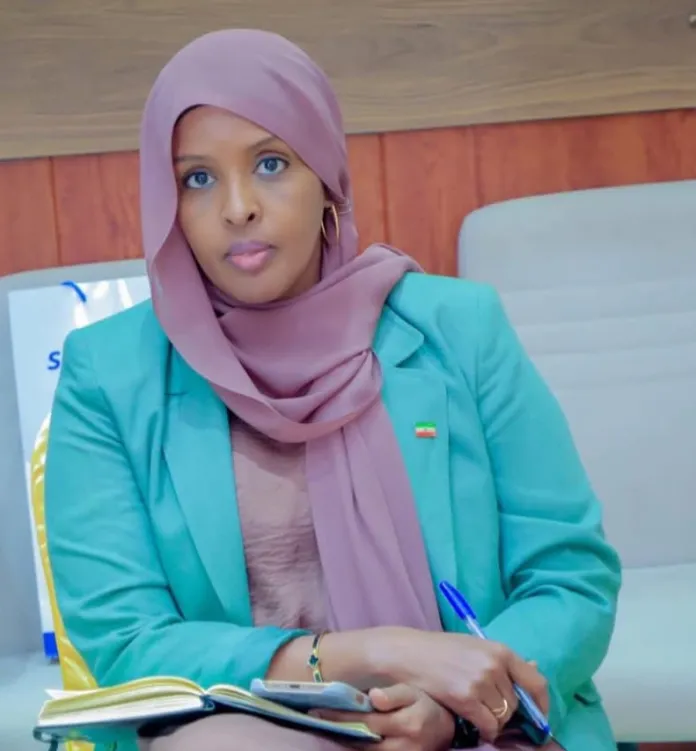
Salma Sheikh is a political analyst, a longtime Somaliland recognition advocate, and Lead Advisor on Women Affairs at the House of Representatives of the Republic of Somaliland.
By Salma Sheikh