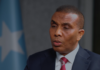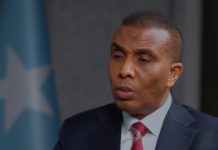





Somalia’s Minister of Defense, Ahmed Moallim Fiqi, issued a stern warning to opposition politicians regarding the dangers posed by the mobilization of forces, the formation of militias, and any actions that could undermine the country’s security and stability.
Fiqi stated that there would be no tolerance for anyone attempting to compromise national security, specifically addressing opposition politicians accused of mobilizing troops or militias.
“No leniency should be shown to anyone who acts to harm security. If these opposition figures mobilize militias, they must be dealt with using an iron fist.”
This statement comes at a sensitive political time for Somalia, amidst ongoing disputes between the federal government and certain opposition politicians and regional states.
The Defense Minister emphasized the value of Somalia’s security, noting the significant sacrifices of life and resources the country has made to achieve peace and stability.
Fiqi asserted that it is unacceptable for any political group or individual to jeopardize national security after the immense effort and loss of Somali lives invested in securing the country. “The security for which we lost a dear brother is being compromised for a mere four million,” said Fiqi, reiterating his call for no leniency toward anyone attempting to undermine security.
This statement highlights the federal government’s view of security as a top priority, particularly at a time when Somali forces are still battling Al-Shabaab and the government is striving to fully assume responsibility for the country’s security.
Fiqi’s warning marks yet another instance of the federal government accusing the opposition of introducing military force into the political arena.
During the political tensions and clashes in Mogadishu in 2026, Fiqi accused the opposition of militarizing the political situation, stating that the government would not tolerate the seizure of power or the obstruction of the government through the use of force and militias.
These accusations arose amidst a highly volatile political climate, with both the government and the opposition blaming each other for the deteriorating situation.
For their part, some opposition politicians accused the government of deploying state security forces to exert political pressure on the opposition.
Consequently, Fiqi’s remarks come at a time when the two sides are at odds over issues concerning state power, elections, the constitution, and the governance of the country.
Somalia has long grappled with the consequences of injecting military force and militias—driven by political or regional interests—into the political landscape. When a political group possesses its own military forces or militias, the risk of armed conflict can escalate—particularly if a political dispute reaches a point where it can no longer be resolved through dialogue.
Somalia’s history demonstrates that political disputes escalating into armed conflict can lead to displacement, loss of life, destruction of property, and the weakening of government institutions.
Consequently, Fiqi’s warning addresses a critical security issue: that military forces and weaponry must not become tools for resolving political disputes.
Fiqi’s remarks also come at a time when the federal government is prioritizing the development and self-reliance of Somalia’s security forces.
In early September 2026, the National Internal Security Conference was held in Mogadishu to discuss how Somalia would manage its own security as African Union forces began scaling down their presence.
At the conference, Fiqi stated that Somalia is prepared for a Somali-led security model characterized by accountability, transparent management, and sustainable financing.
The meeting also took place at a time when the government is facing challenges regarding troop numbers, funding for the military, and the coordination of security agencies.
One of the major issues currently facing the government is how Somali forces can fully take over the country’s security.
African Union forces (AUSSOM) continue to play a role in supporting Somali troops, but Somalia has long maintained its desire for the national army to gradually assume responsibility for security.
A report by *The EastAfrican* in September stated that Somali officials are working on a new security framework to prepare the country for the eventual reduction of the African Union forces’ presence.
In recent years, government forces have been conducting operations against Al-Shabaab across many parts of the country, with the government and its international partners carrying out both military and intelligence operations.
The Ministry of Defence has also stated that Somalia is making efforts to build a force capable of independently conducting security operations.
At the same time, the government faces challenges related to funding, equipment, training, and the sustainability of the armed forces. This situation explains why Fiqi and other government officials consistently emphasize the need to prevent political disputes from escalating into armed conflict.
Fiqi’s statements can be understood as a direct message to opposition politicians: the federal government seeks to resolve political disagreements through political processes rather than through the use of military forces or militias.
However, the allegation that the opposition is mobilizing militias requires concrete evidence when specific individuals or groups are accused.
The opposition and the federal government hold differing views on many issues; it is crucial that such allegations be based on verifiable evidence to avoid further heightening political tensions.
The government bears the responsibility of protecting the public and countering any illegal armed groups.
However, at the same time, any security measure must be implemented in accordance with the law, while upholding citizens’ rights and the principle of accountability.
This is crucial for Somalia, a country that is still building its security institutions and governance systems.
While issuing a stern warning to armed groups may serve a security purpose, when such warnings are directed at the political opposition, it becomes increasingly important to distinguish between political dissent and criminal or armed activity.
Fiqi specifically warned against the mobilization of militias, stating that anyone involved in such actions would face strict measures.
His remarks come at a critical juncture for Somalia regarding both security and politics. The government is striving to strengthen the national armed forces while preparing to fully assume responsibility for the country’s security.
Meanwhile, the dispute between the government and the opposition remains a sensitive political issue.
It is essential that political differences be resolved through dialogue, legal processes, and political mechanisms, avoiding the use of weapons or military force in political contests. Fiqi’s remarks therefore highlight two interconnected issues: Somalia’s need for robust security and the necessity of preventing political disputes from escalating into armed conflict.
Ahmed Moallim Fiqi has served as Minister of Defence since April 2025, having taken over the role from his predecessor.